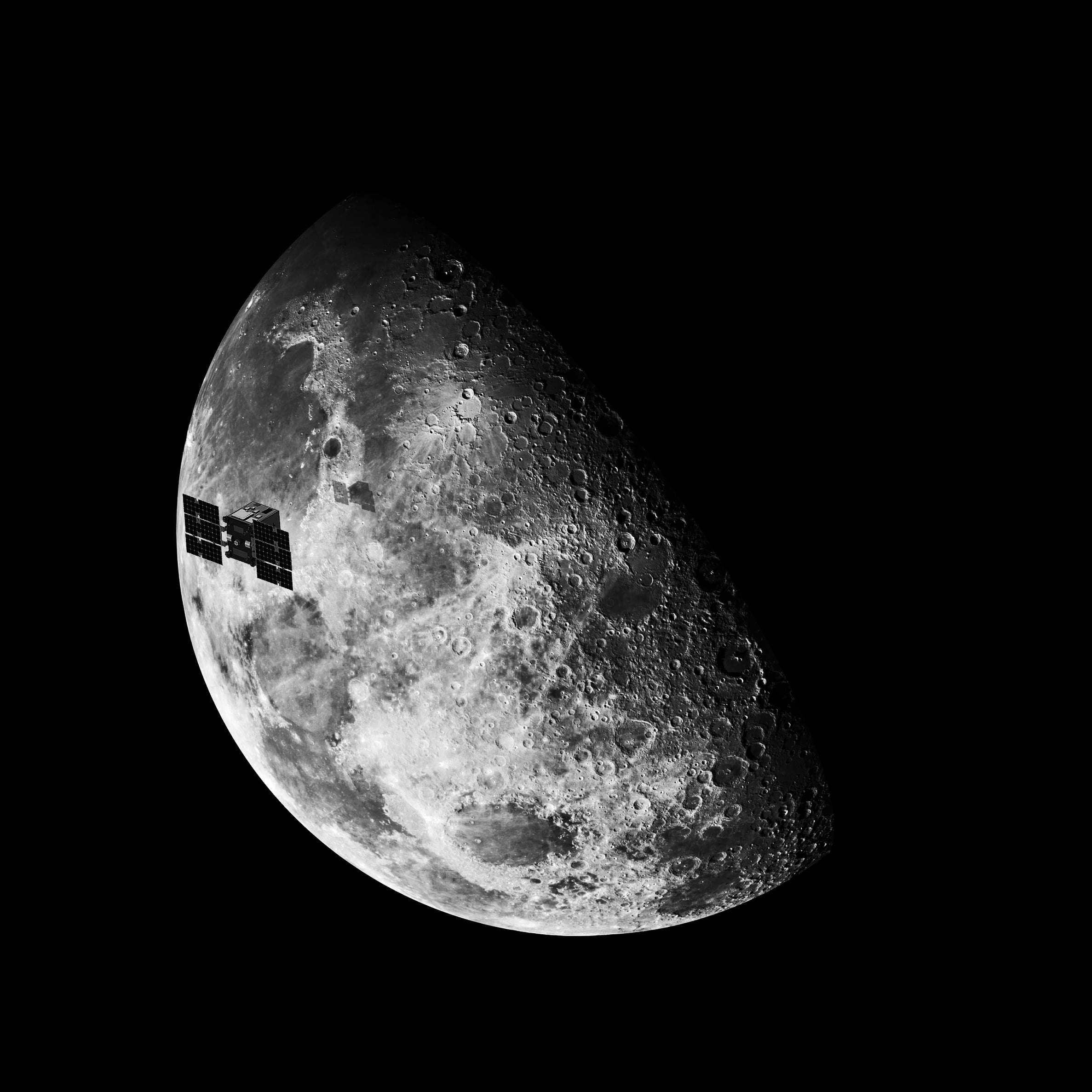
Benchmark Space Systems has been selected by DARPA to conduct a Phase 1A/1B feasibility and design study under the Lunar Assay via Small Satellite Orbiter (LASSO) program.
Water concentration to find, detected with greater than 90% probability
4
km2
Resolution no larger than four square kilometers
100
%
Coverage of the entire lunar surface
<
4
yrs
Data collection within four years
Why lunar water matters
Water makes staying possible
Propellant in orbit limits how far and how often spacecraft can move around the solar system. Water on the Moon could be split into oxygen and hydrogen, the ingredients of a high-performance chemical rocket propellant.
Fly it
Liquid hydrogen and oxygen is the propellant pairing that changes the map for where spacecraft can go.
Drink it
Crew consumables
Breathe it
Oxygen for life support
Hide behind it
Radiation shielding
From ice to propellant
H2OWater ice, 9 parts by mass
↓ Electrolysis splits the water
Oxygen8 parts
H1
Oxygen is most of the mass of many rocket propellants, and oxygen is the half the Moon can supply.
01
Less to launch
Today, everything a lunar mission uses is launched from Earth. Water already at the Moon could supply drinking water, oxygen and propellant for crews and spacecraft.
02
A lasting presence on the Moon
NASA's Artemis missions aim to return crews to the Moon and build toward a sustained presence. Knowing where lunar water is, and how much, supports NASA's Moon to Mars Architecture and can inform where crews and base camps operate.
03
A resource you can plan around
Finding signs of water is one step. Planners need to know where it is, how much there is, and how sure we are.
Explore the Moon
Where to learn more about the Moon
NASA
NASA Earth's Moon
NASA's lunar science hub, covering the Moon's composition, craters, phases, formation and water.